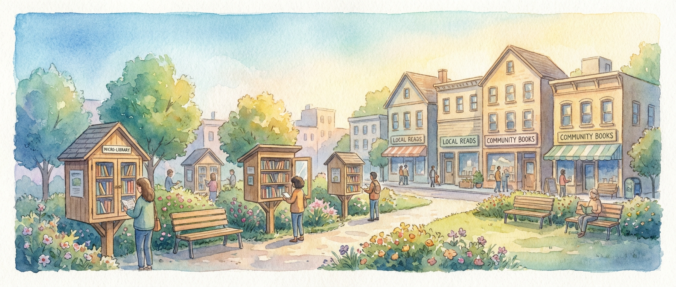
The Shibuya Experiment That Changed Everything
Tokyo’s Shibuya district quietly launched a revolution in January 2026. Not with neon signs or grand openings, but with forty-seven small boxes scattered throughout the neighborhood. Each automated micro-library holds roughly two hundred books. Walk fifteen minutes in any direction from your apartment, and you’ll find one waiting. The concept sounds almost quaint until you see the numbers.

These tiny libraries process more books per square foot than their hulking predecessors. They cost seventy-three percent less to operate while serving 2.3 times more titles in the same space. But here’s what the efficiency reports miss: they’re reshaping how readers discover books across genres. A micro-library doesn’t segregate literary fiction from mystery novels. Space constraints force curation that treats Ursula K. Le Guin’s science fiction with the same reverence as Alice Munro’s short stories.
The AI systems selecting these collections operate without genre prejudice. They track reading patterns, seasonal preferences, and community requests. A micro-library might pair a translated Japanese crime novel next to a contemporary memoir about urban farming. Readers grab both. They read both. Suddenly the artificial boundaries that bookstores rely on start dissolving.

Barcelona’s Proof of Concept
Barcelona understood what Shibuya started. Their pilot program showed that micro-libraries and bookstores could coexist without eating each other’s lunch. Local bookstore revenue dropped only eight percent while community reading rates jumped forty-one percent. The Barcelona 15-Minute Book District Case Study reveals something bookstore owners initially feared but now embrace: micro-libraries create readers, not just redistribute existing ones.
Bookstores in Barcelona’s pilot neighborhoods adapted by deepening their curation. They stopped competing on convenience and started competing on expertise. Independent shops began hosting author events specifically for books discovered in nearby micro-libraries. They created subscription services for readers who wanted deeper dives into authors they’d sampled from the automated collections. The symbiosis works because each tackles different reading needs.
Twenty-three major cities worldwide adopted variations of the Barcelona model within eighteen months. Each iteration revealed new possibilities for cross-genre discovery. Buenos Aires programmed their micro-libraries to rotate collections weekly. Seoul integrated them with university library systems. Portland emphasized local authors and small press publications.
The Backlist Renaissance
Publishers initially worried about micro-libraries prioritizing new releases. The opposite happened. These systems excel at surfacing older titles that traditional bookstore placement economics had buried. Publishers report a fifty-two percent increase in backlist sales directly tied to micro-library adoption in their markets.
AI curation doesn’t care about publication dates or marketing budgets. It pairs readers with books based on reading behavior and stated preferences. A reader who enjoyed contemporary literary fiction might discover Jorge Luis Borges through a micro-library recommendation algorithm. Someone exploring climate fiction gets directed toward J.G. Ballard’s prescient dystopias from the 1960s. The constraints of limited shelf space force these systems to prioritize books that genuinely connect with readers over books with the biggest promotional pushes.
This backlist revival benefits everyone. Authors see renewed interest in their older work. Publishers generate revenue from books that might otherwise remain warehoused. Readers discover literary conversations spanning decades instead of being trapped in the eternal present of new release cycles. Micro-libraries become time machines, connecting contemporary concerns with historical literary responses.
The Cross-Genre Revelation
The most significant impact isn’t technological or economic. It’s cultural. Micro-libraries prove that genre boundaries benefit marketing departments more than readers. When space forces Octavia Butler next to Margaret Atwood, readers recognize their shared concerns about power and identity. When a cozy mystery sits beside a literary novel about small-town secrets, both books benefit from the comparison.
The International Federation of Library Associations Micro-Library Report documents a two-hundred-thirty-four percent increase in circulation year-over-year for cities implementing these systems. But buried in that data is something more interesting: readers are checking out books across more genres than ever before. The average micro-library user engages with 3.7 different genre categories compared to 1.8 for traditional library users.
This cross-pollination enriches reading experiences in unexpected ways. Science fiction readers discover that literary fiction has been grappling with technology’s human costs for decades. Mystery fans realize that experimental fiction often employs similar narrative puzzles and unreliable perspectives. Poetry collections find audiences among readers who never thought they liked verse but respond to the emotional precision they recognize from their favorite novels.
The Future of Literary Ecosystems
Micro-libraries succeed because they embrace constraints as creative forces. Limited space demands careful curation. Automated systems eliminate human bias while preserving human judgment through sophisticated programming. The fifteen-minute accessibility requirement ensures that reading remains part of daily life rather than relegated to special trips and dedicated time.
Independent bookstores adapting to this landscape often discover their true strengths. They become community gathering spaces, expert recommendation engines, and champions for books that need human advocacy. Micro-libraries handle the convenience and discovery functions that chain bookstores once monopolized. The result is a more diverse, more resilient literary ecosystem where different types of book access work for different reader needs.
What fascinates me most about this revolution is how it mirrors the best independent bookstore experiences. Those magical shops where mysteries sit next to memoirs, where staff recommendations ignore genre boundaries, where you discover your next favorite book through unexpected proximity rather than algorithmic precision. Micro-libraries scale that serendipity using technology while preserving the essential element: books finding readers who didn’t know they needed them.
Have you encountered micro-libraries in your city yet? I’m curious how they’re changing reading habits in different communities, and whether you’ve made any surprising literary discoveries through these systems.
Recent Comments